

🧠 Change Your Mind, Change Your World
How Reframing Your Child’s Behaviour Changes Theirs Too
(StoryMii Parenting Insights — emotional regulation • executive function • mindset)
Maybe it starts with something small.
Your child interrupts you for the fifth time.
They leave their backpack in the middle of the hallway again.
You hear yourself say it before you mean to:
“Can you please just focus?”
We’ve all been there. Parenting can feel like a loop of reminders, frustration and guilt. You want to be patient, but by the end of the day, it’s hard to see past the surface of your child’s behaviour.
The truth is, the way we see our child in those moments can change what happens next.
🧠 What’s Really Going On Beneath the Behaviour
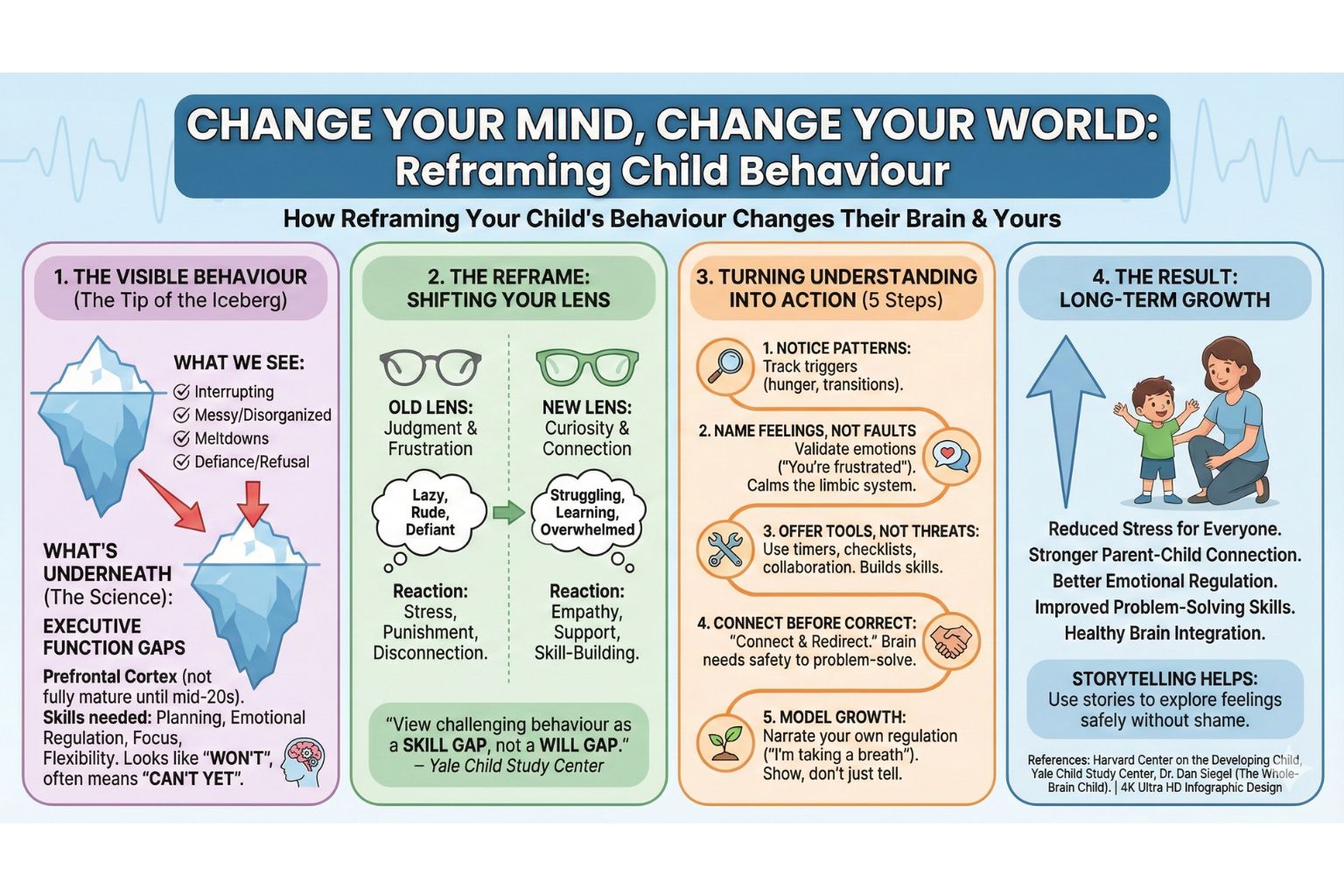
When a child struggles to start homework, interrupts, forgets things, or melts down when plans change, it’s easy to label it: lazy, rude, defiant, careless.
But neuroscience tells a different story.
Many of these behaviours are linked to executive function — the brain’s ability to plan, organise, regulate emotions, and stay focused. These skills are managed by the prefrontal cortex, which doesn’t fully mature until the mid-twenties (Harvard Center on the Developing Child, 2023).
That means what looks like “won’t” often means “can’t yet.”
Children aren’t born with strong self-regulation, planning or flexibility. They learn those skills through practice, modeling and support — the same way they learn to tie their shoes or read.
Research from the Yale Child Study Center shows that when adults view challenging behaviour as a skill gap instead of a will gap, both parents and children experience less stress and more positive interaction (Miller et al., 2018).
In other words, the story we tell ourselves about our child shapes how we respond — and how their brain grows.
💬 The Power of a Mindset Shift
Psychologists call this reframing. Instead of seeing the behaviour as defiance, we see it as communication.
- “He’s being lazy” becomes “He’s struggling to get started.”
- “She’s disorganized” becomes “She’s still learning executive function.”
- “He’s interrupting” becomes “He’s excited and wants to connect.”
This doesn’t mean excusing poor behaviour. It means understanding what’s driving it, so we can teach the skill instead of punishing the symptom.
Research from the Center on the Developing Child shows that positive reframing supports brain integration — linking emotional and rational parts of the brain through calm, connected interaction. Over time, that helps children manage impulses and problem-solve more effectively.
✨ Turning Understanding Into Action
Awareness is only the first step. The next is finding small, repeatable ways to help your child build the skills they’re missing.
Here are a few science-backed ways to turn reframing into growth:
1. Notice the Pattern Before the Problem
Keep track of when your child’s hardest moments happen.
Is it during transitions? Homework? Social situations?
Patterns often point to specific skills — like emotional regulation, attention, or task initiation — that need support.
2. Name the Feeling, Not the Fault
Instead of “Stop being dramatic,” try “You’re frustrated that it’s not working yet.”
Labeling emotions helps calm the limbic system and teaches children language for self-regulation (Siegel & Bryson, The Whole-Brain Child, 2012).
3. Offer Tools, Not Threats
When a child’s executive skills are underdeveloped, threats (“If you don’t clean up, no screen time”) activate stress, not learning.
Instead, try a tool-based approach: “Let’s set a timer for five minutes and do it together.”
This teaches initiation, sequencing and persistence — the real skills behind “focus.”
4. Build Connection Before Correction
Neuroscientist Dr. Dan Siegel calls this “connect and redirect.”
When children feel understood, their brains literally shift from reactivity to reasoning.
A calm, validating tone helps the brain re-engage with problem-solving.
5. Model What Growth Looks Like
When you lose patience, name it: “I got frustrated, but I’m going to take a breath and try again.”
You’re not showing weakness. You’re showing how regulation works.
🌱 How Storytelling Helps
Stories give children a safe way to explore frustration, perseverance and empathy without shame. When a character faces the same struggles they do — getting distracted, feeling misunderstood, trying again — it helps them externalize the problem and imagine solutions.
Interactive storytelling platforms like StoryMii are built around this idea. By letting children create stories that reflect their feelings and decisions, they practice emotional awareness and problem-solving through play — key ingredients in executive function growth.
❤️ The Takeaway
Children who struggle with focus, flexibility or frustration aren’t broken or disobedient. They’re learning skills their brains haven’t mastered yet.
The way we interpret their behaviour changes how they see themselves.
And the more we see the struggle beneath the surface, the more we can respond with calm, empathy and practical support.
Changing our mindset doesn’t just make parenting easier.
It helps our children build the skills they need to thrive.
📚 References
Harvard Center on the Developing Child.
Executive Function and Self-Regulation. 2023.
https://developingchild.harvard.edu/science/key-concepts/executive-function/
Miller, A. L., et al.
Parenting Mindsets and Child Behavior Outcomes. Yale Child Study Center, 2018.
https://medicine.yale.edu/news-article/how-parenting-mindsets-shape-child-behavior-and-well-being/
Siegel, D. J., & Bryson, T. P.
The Whole-Brain Child. Bantam Books, 2012.
https://drdansiegel.com/book/the-whole-brain-child/
Center on the Developing Child.
Serve and Return Interaction Shapes Brain Architecture. 2017.
https://developingchild.harvard.edu/science/key-concepts/serve-and-return/
Barkley, R. A.
Executive Functions: What They Are, How They Work, and Why They Evolved. Guilford Press, 2012.
https://www.guilford.com/books/Executive-Functions/Russell-A-Barkley/9781462505379